Building on the previous lesson's exploration of possession, this week we focus on the various meanings of "title" and their application in the context of Indigenous land rights recognized by Anglo-Canadian law.
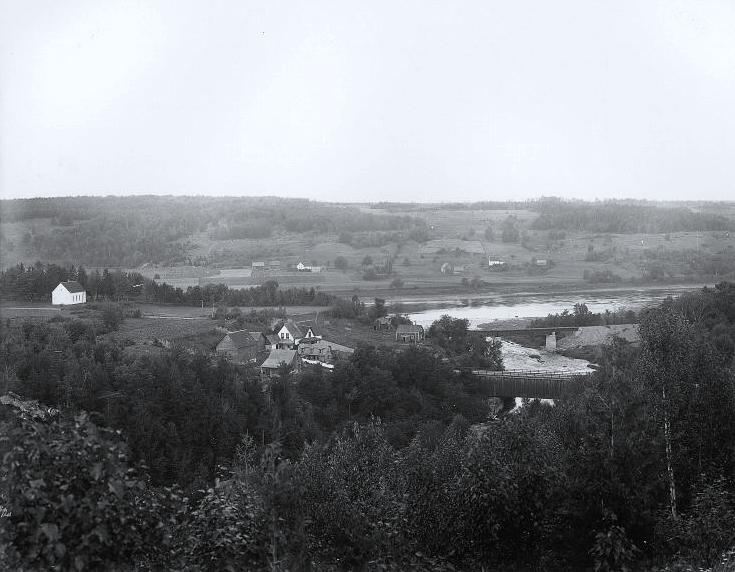
Wolastoq at Eel River Bridge (1915), Wikimedia Commons
Learning Objectives
Learning objectives are statements about the skills, knowledge and attitudes learners will acquire or develop when they complete this lesson.
By the end of this week, you should be able to:
- Explain the changing role of the Royal Proclamation, 1763 with respect to the source and content of common law Aboriginal Title.
- Describe the general features of Aboriginal Title as late-19th century courts understood it (in concept, if not in name).
- Link the doctrinal development of Aboriginal title to the structure of feudal land tenure and the common law estates in land.
- Identify legal developments that legitimated and enabled the logic of settler colonialism in the 19th century.
In Week 2, we started to explore the important place of “possession” in Anglo-Canadian law going back to some of its deeper roots in the liberal theory of writers like John Locke. In the course of that exploration, we situated possession as just one possible form of legal land relation and got some early sense of its challenges and limitations as a basis of property. Joseph William Singer elaborates on this theme:1
Where do property rights come from? If you believe the property casebooks, we acquire original title to property by conquering other nations, hunting animals, catching baseballs, encroaching on our neighbors’ lands, drilling for oil, and finding lost jewels. You’ve heard the expression “possession is nine-tenths of the law.” It turns out it’s actually true. If you can take it, you can keep it–not exactly the most morally attractive justification for the rights of owners. Imagine teaching your children that the way to get things is to grab whatever they can. But maybe there is something to the possession theory. What would we have to believe to make possession a just original source of title to property?
Possession is plausible as a source of title only if you are not taking something that already belongs to someone else. If you are the first possessor of an unowned object, like a wild animal or a deserted island, possession is like magic; it allows you to create something out of nothing. Who could reasonably object to your claim? No one has been displaced by your act of occupation and everyone else is perfectly free to go out and hunt their own foxes and discover their own uncharted shores.
Two problems disturb this rosy scenario. First, the magic disappears if you take all the cookies on the plate and leave none for your little sister. As John Locke recognized long ago, possession raises no moral issues only as long as it does not deprive others of similar paths to ownership. Locke argued that property rights in land were justified only if “there is enough, and as good left in common for others.” This little caveat is affectionately called the “Lockean proviso.” If I occupy land and others do not have equal opportunities to do the same thing, then my act of first possession cannot be considered to be what John Stuart Mill called a self-regarding act; rather, my actions impose externalities on others. And those externalities are not minor in nature; because human justified need things to survive, monopolizing things needed for human life can only be justified if others have equal opportunity to get what they need? This makes the relationship between possession and equal opportunity a central problem.
The second wrinkle with the original possession idea is the unfortunate fact that most things already do have owners, and if you grab something originally possessed by someone else, then you are not a first possessor. When you dispossess another possessor, you have done something wrong. We have words for someone like you and they are not pretty words; if you take someone else’s car we call you a thief and if you take someone else’s country we use words like imperialist and conqueror. When you steal a car, your title is no good no matter how long you possess it… But conquest is another matter; here is a case where theft does confer legal rights. International law may condemn conquest, but it also rewards the conquerors with sovereignty. As Thucydides reports in The Peloponnesian War, the Athenians justified their conquest of Melos by arguing “you know as well as we do that right, as the world goes, is only in question between equals in power, while the strong do what they can and the weak suffer what they must.”
As Singer goes on to observe, “this is not merely a theoretical problem”: when Europeans first came to North America, it was not empty land. Thus, if “first possession is the legitimate origin of title” then non-Indigenous peoples “cannot trace our titles to a just origin.”2
Our materials this week examine this problem in more detail, focusing on the period of rising settler colonialism in 19th century British North America in which British and later Canadian law and legal institutions sought to legitimize the assertion of British sovereignty and settler land titles while simultaneously denying the existence of Indigenous rights and legal orders–in a stark departure from the era of imperialist concerns and treaty-making-as-international-order that we discussed in Week 2.
Weekly Problem: Wolastoqey and MTI Title Claims
After you have read through the background for this week's lesson above, your next step is to review the weekly problem.
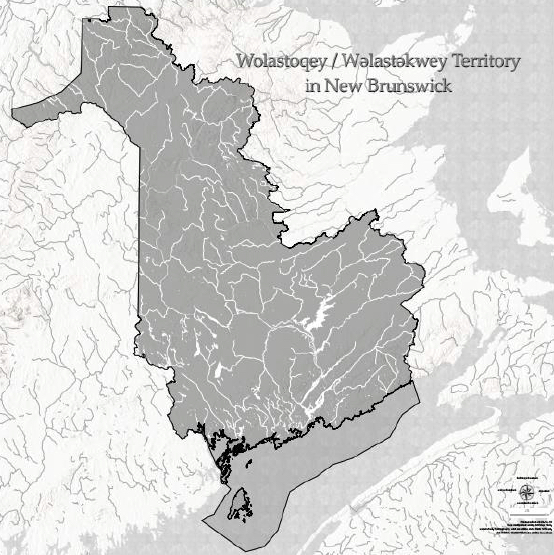
Two claims for recognition of "Aboriginal Title" in New Brunswick under section 35 of the Constitution Act have been launched in recent years. This problem explores how these territories came to be understood in Canadian law as subject to both the Crown's radical title and to the common law estates of private parties.