The Province of Manitoba exercises its statutory authority to flood regions upstream of Winnipeg in the course of operating the city's floodway, while a local municipality amends its bylaw to prevent adjacent land-uses.
Engineers and Geoscientists of Manitoba, https://heritage.enggeomb.ca
Hypothetical Facts #
The following hypothetical builds on a recent case before the Manitoba Court of Appeal,1 which reports these facts:
A Maze in Corn Inc. operates a corn maze, petting zoo and haunted forest attraction (the business) on a property located on St. Mary’s Road, south of Winnipeg near St. Adolphe (the property). The property is located south of the gates of the Red River Floodway (the floodway).
The Red River runs through the City of Winnipeg, which is located on the Red River flood plain. In years of unusually high water, the river overflows its banks and causes widespread flooding and sewer back-ups in Winnipeg, resulting in significant property damage and economic loss.
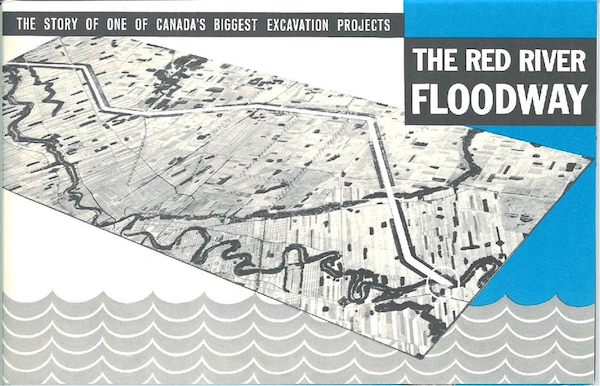
The floodway, which was built in 1962 and 1968 and expanded in 1997, is a structure that includes a large ditch (the floodway channel) to divert water around Winnipeg. The flow of water is controlled by a floodway control structure (the gates) on the south side of Winnipeg that diverts water from the Red River into the floodway channel. When the gates are activated, the flow of water through the city is reduced and flooding in Winnipeg is either prevented or reduced. Unfortunately, the operation of the floodway causes water to back up to the south (i.e., upstream) of the gates, flooding properties to the south.
[…]
In 2019, the fall conditions in the Red River basin were much wetter than normal. The Manitoba Department of Water Stewardship (the Department) had determined that precipitation conditions posed a risk of unusually high water levels, which could potentially cause sewer back-up damage to homes in Winnipeg. It concluded that the artificial flooding to rural properties upstream (to the south) from the gates would be financially less costly than the projected sewer back-up damage within Winnipeg. In anticipation that this flooding would occur, the Department was in communication with A Maze in Corn about potential flood impacts.
The floodway gates were operated from October 9 to November 7, 2019, resulting in the anticipated severe unnatural flooding for miles upstream, including the property. The flooding was immediate and severe, completely flooding the “Haunted House” feature of the business within hours.
Suppose that, in addition to the facts described above, the Department is empowered under provincial regulations pursuant to The Red River Floodway Act, CCSM, c R32, to operate the floodway when “the expected benefits of doing so clearly and substantially outweigh the expected costs”. However, because the flooding in this particular year was so extreme, operation of the floodway did nothing to actually reduce downstream flooding as anticipated and resulted in widespread damage to many homes and businesses within the City of Winnipeg.
Meanwhile, although the A Maze in Corn Inc. was initially resigned to closing their business when the floods hit, members of the public using the river for recreation soon discovered that they could access and maneuver through the half-submerged corn maze by boat. A few posts on social media turned this into a major local attraction. By the end of November, the flood waters had receded and the business could again operate the corn maze and petting zoo in their normal fashion.
After the flood, in April of the following year, the regional municipality encompassing St. Adolphe decided that it needed to take further steps to prevent flood losses among its residents in the future. It enacted a new municipal plan and zoning bylaw that required all land within 100 metres of the banks of the Red River to “remain unused in its natural state” and removed all pre-existing uses in the zone, which had included both agricultural and commercial uses. The following season, after the bylaw was passed, A Maze in Corn Inc. decided that it would restructure its business, converting an existing barn that had been part of the petting zoo for use in a medium-sized pasture-raised pork farm–about which a few of the neighbours complained due to some modest smells come mid-summer.
The Problem #
Would A Maze in Corn Inc. likely be successful in making a claim for compensation against either the province or the municipality? Whether or not it was successful in doing so, would the business be prohibited by the new municipal bylaw from operating its hog farm?
For the purposes of this hypothetical, you can assume that Manitoba’s legislation governing expropriation is the same as analogous legislation in Nova Scotia.
A Note on Readings #
The readings this week cover two related but distinct topics: constructive takings and acquired rights. I suggest first reading the line of cases on constructive takings in chronological order (Mariner, CPR and Annapolis) along with the relevant legislation (Expropriation Act), followed by the cases on acquired rights (Cappy and Saint Romauld (City)) along with the relevant legislation (Planning Act).
-
A Maze in Corn Inc v. Manitoba Emergency Measures Organization et al, 2023 MBCA 92, 2023 CarswellMan 372, [2024] 3 W.W.R. 385, 2023 A.C.W.S. 5307 ↩︎
Readings for this Week
Choose one of the reading materials from the list below--ordered alphabetically--to start analyzing this week's problem. At the end of your reading path you should have covered each of the materials on the list.
- Annapolis Group Inc. v Halifax Regional Municipality, 2022 SCC 36: Halifax Regional Municipality (HRM) zoned land owned by Annapolis to preclude development without approval from the municipality. HRM then refused to grant Annapolis Group's requests to develop the land and allegedly treated the land as a public park.
- Canadian Pacific Railway Co. v Vancouver (City), 2006 SCC 5 (CanLII): BC granted land to CPR to build a railway line. Traffic declined, and CPR proposed to redevelop the land for residential and commercial use or sell the land to the city. Instead, Vancouver passed a bylaw that designated the land for public use and transportation.
- Expropriation Act, RSNS 1989, c 156: Provincial legislation addressing the expropriation ('taking') of land.
- Mariner Real Estate Ltd v Nova Scotia (Attorney General), 1999 NSCA 98 (CanLII): Mariner's land was classed as a beach, which involved numerous restrictions, and meant ministerial permission was necessary to construct a dwelling. The Minister refused to grant permission for the claimant to build a home.
- Planning Act, CCSM, c P80: Provincial legislation addressing legal non-conforming uses.
- R v Cappy, 1952 CarswellOnt 287, 1952 CanLII 280 (ON CA): The defendant a stadium in 1951 and began to conduct stock car racing on it. In 1948, the municipality had passed a bylaw that prohibited the use of land for non-residential purposes except where they were a continuation of pre-existing use. The stadium had previously been used for entertainment purposes, including some racing of other kinds, but not stock car racing.
- Saint-Romuald (City) v Olivier, 2001 SCC 57 (CanLII), [2001] 2 SCR 898: Olivier's nightclub changed their entertainment from singing cowboys and cowgirls to nude dancers. New zoning law restricted nightclubs in the area, so Olivier's bar could only operate if the new entertainment was a continuation of pre-existing use.