This week's problem builds from a public radio documentary surrounding a restrictive covenant impeding a municipality's plans to build affordable housing in the city of Austin, Texas.
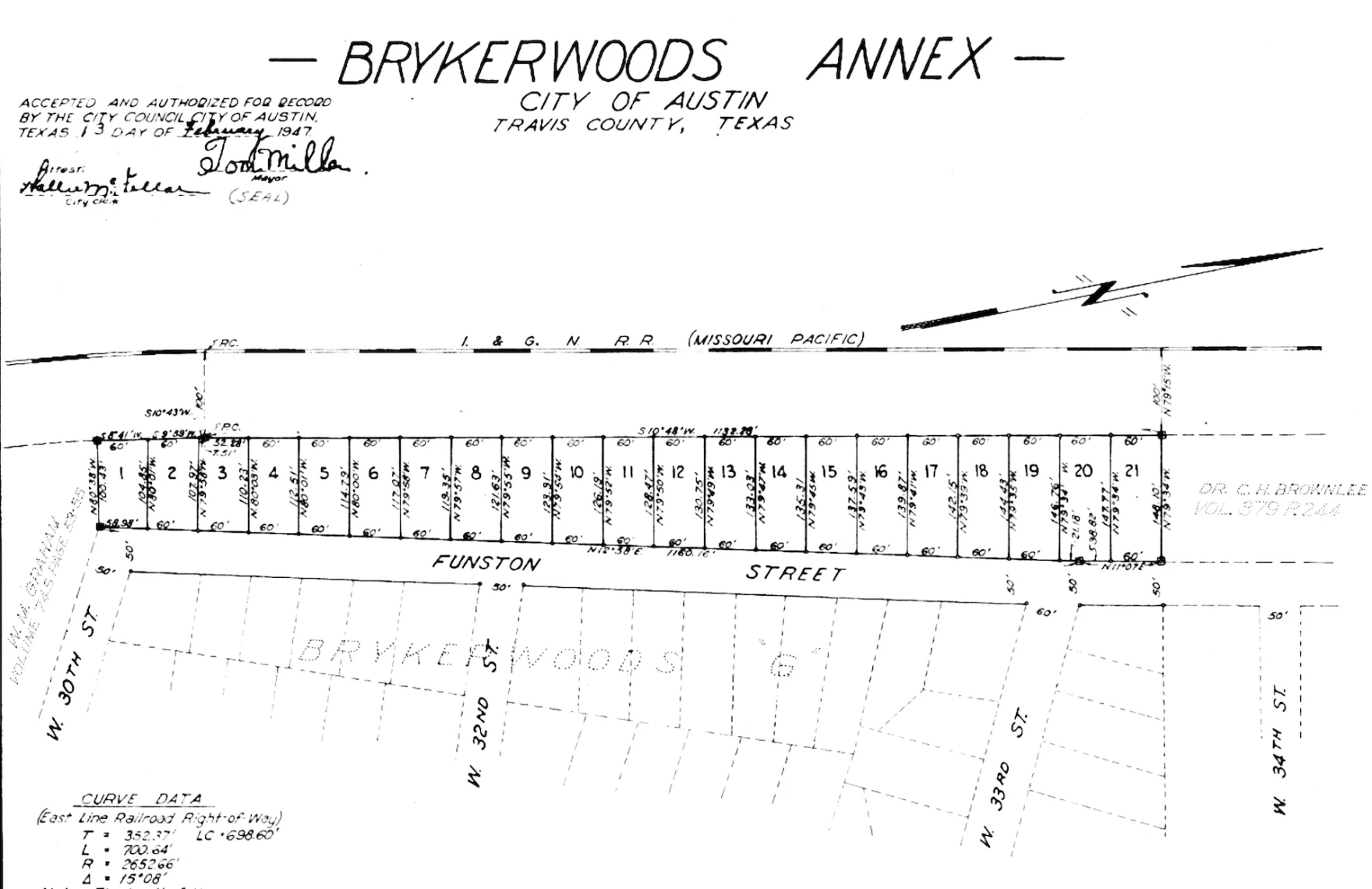
Scan of the Brykerwoods neighborhood's restrictive covenant - KUT News
Please listen to this NPR Radio documentary about 3000 Funston Street, a piece of vacant land in the Brykerwoods neighbourhood of Austin, Texas. The podcast tells the story of how a restrictive covenant is shaping urban development in the context of the city’s long-term strategy to improve access to affordable housing and achieve a more equitable distribution of that housing across the municipality. If you prefer, the website also contains a print version of the radio documentary.
The provisions of the restrictive covenant at 3000 Funston Street are included on the website–they are as follows:
All lots in Brukenwoods Annex shall be subject to the following restrictions, covenants and conditions:
All lots in the tract shall be known and described as residential lots. No structures shall be erected, altered, placed or permitted to remain on any residential building plot other than one detached single family residence, or one duplex apartment, except that private garages for not more than three cars may be constructed and may be attached to or detached from the main residence structure, and servants quarters or one garage apartment may be constructed only after the main residence structure is completed.
No building shall be located on any residential building plot nearer than 25 ft. to the front lot line, no nearer than 12 ft. to any side street line. No building except a garage or other out-building located 90 ft. or more from the front lot line shall be located nearer than 5 ft. to any side lot line.
No residential structure shall be erected or placed on any building plot, which lot has an area of less than 5750 square ft. or a width of less than 50 ft. at the front building setback line as shown on the recorded plat.
No noxious or offensive trade or activity shall be carried on upon any lot, nor shall anything be done thereon which may be or become and annoyance or nuisance to the neighbourhood.
No persons of any race other than the white race shall use or occupy any building or any lot, except that this covenant shall not prevent occupant by domestic servants of a different race domiciled with an owner or tenant.
No trailer, basement, tent, shack, garage, barn or other out-building erected in the tract shall at any time be used as a residence temporarily or permanently, nor shall any structure of a temporary character be used as a residence.
The ground floor area on the main residence structure erected on any building plot shall not be less than 750 square feet for Lots 1 to 16, inclusive, and not less than 850 square feed for Lots 17 to 21, inclusive, each being exclusive of one story open porches and garages.
These covenants are to run with the land and shall be binding on all parts and all persons claiming under them until January 1, 1966 at which time said covenants shall be automatically extended for successive periods of ten years unless by vote of the majority of the then owners of the lots it is agreed to change the said covenants in whole or in part.
If the parties hereto or any of them or their heirs or assigns shall violate or attempt to violate any of the covenants herein, it shall be lawful for any other person or persons owning any real property situated in said development or subdivision to prospector any proceedings at law or in equity against the person or person violating or attempting to violate any such covenant and whether to prevent him or them from so doing or to recover damages or other dues for such violations.
Invalidation of any one of these covenants by judgement or court order shall in no wise affect any of the other provisions which shall remain in full force and effect.
Suppose that the facts surrounding 3000 Funston Street take place in a Canadian city like Halifax. Which provisions of the restrictive covenant above might limit the use of the land for the development of affordable housing as envisioned by the City of Austin? Would such provisions be valid and enforceable in Canadian law?
Both Canada and the United States have a long, troubling history of upholding the type of racially restrictive covenants seen in Clause 5 of the 3000 Funston Street covenant. These clauses are no longer enforceable in Canadian law (though in some places, like this West Vancouver neighbourhood, such clauses formally remain on title).
But suppose that one of the residents of Funston Street makes a will, naming their two surviving adult children as the sole beneficiaries. The will establishes a private trust with the eldest child as trustee, the terms of which stipulate that the youngest only receive their share of the trust property if and when they divorce and cease to cohabitate with their spouse. If the youngest child fails to meet this condition within five years of the testator’s decease, the whole residue of the estate will pass to the other beneficiary.
After the will takes effect, the youngest child brings an action challenging the validity of the will. They argue that it is well known within the family that the condition was included because the testator held strident anti-immigration views and–in the testator’s own words–“disapproved” of the youngest child having married their spouse, a recent immigrant to Canada. While the will itself makes no mention of the reasons for the bequest or the specific condition, the youngest child claims to possess written and oral evidence outside the will that expresses the testator’s discriminatory intent.
How would you describe the property interests created in the bequest? Do you think the youngest child is likely to succeed in challenging the will?
A Note on Readings #
The readings this week again cover two related but distinct topics: restrictive covenants and qualified interests. I suggest first reading the cases concerning restrictive covenants (Re Drummond Wren, Noble et al v Alley) and then reading those concerning qualified interests (Stuartburn v Kiansky, Canada Trust Co v Ontario, and McCorkill v McCorkill Estate). Note that both lines of cases address the common law doctrine of “public policy” and we will discuss this connection at length in class.
Readings for this Week
Choose one of the reading materials from the list below--ordered alphabetically--to start analyzing this week's problem. At the end of your reading path you should have covered each of the materials on the list.
- Canada Trust Co v Ontario (Human Rights Commission), 1990 CanLII 6849 (ON CA), [1990] 74 OR (2d) 481 (CA): The trustee administered a scholarship with racist eligibility provisions. The Ontario Human Rights Commission sought to have these provisions struck down.
- McCorkill v McCorkill (Estate), 2014 NBQB 148 (CanLII): Harry McCorkill died in 2004, leaving his $200,000 estate as an unconditional gift to a US neo-Nazi group. McCorkill's sister challenged the bequest.
- Noble et al v Alley, 1950 CanLII 13 (SCC), [1951] SCR 64: A racially restrictive covenant concerned land forming part of a summer resort development.
- Re Drummond Wren, [1945] OR 778 (HC): Lands purchased by Drummond Wren included a racially restrictive covenant. He sought to have the covenant declared invalid.
- Stuartburn (Municipality) v Kiansky, 2001 MBQB 94 (CanLII): The Municipality of Stuartburn sought to disqualify Kiansky from holding office because an elector must be the owner of land in the area. Kiansky had recently sold a property, but held a remainder fee simple interest in another estate.