A Mi'kmaw hunter pursues a fox through the woods, where it is killed by a dog walking off-leash with its owner. You are asked to consider the possible legal relationships at play in a claim to ownership.
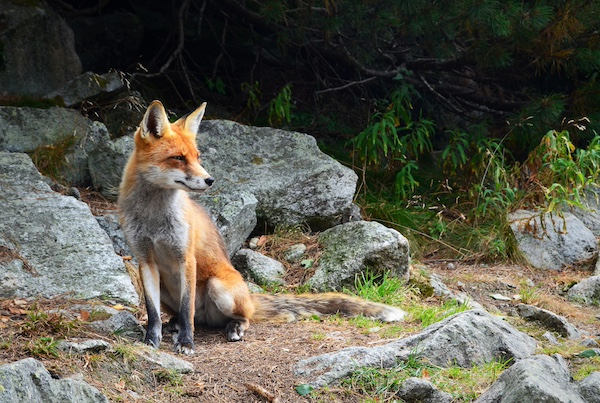
Katerina Bartosova on Unsplash
Writing and speaking about Indigenous Peoples in legal contexts #
Kelti McGloin, a JD student at the Schulich School of Law, and Professor Naiomi Metallic have created an excellent guide called Best Practices for Writing About Indigenous Peoples in the Canadian Legal Context. If some of the terminology in this context is unfamiliar to you, you can use this guide as a reference for in class discussions and in your written work throughout the year.
Hypothetical Facts #
Suppose that the Maw-lukutijik Saqmaq (Assembly of Nova Scotia Mi’kmaw Chiefs) has recently issued a statement underlining the significant role that Mi’kmaq harvesters play in establishing and sustaining healthy forest ecosystems.
A Mi’kmaw hunter pursues a fox (wowkwis, in Mi’kmaq) across a large tract of forest on the Eastern Shore of Mi’kmaki designated by Nova Scotia as provincial Crown Land (i.e. land “vested in the Crown” and “under the administration and control of the Minister” of Lands and Forests pursuant to the Crown Lands Act, RSNS 1989, c 114, s 9). After several hours, the hunter shoots and seriously wounds the wowkiws. Before the hunter can capture it, the fox is attacked and killed by a dog that is walking off leash with its owner, a white settler who lives nearby. Seeing the commotion, a patrolling conservation officer approaches the hunter and asks them to produce a hunting license as required by the Wildlife Act, RSNS 1989, c 504.
The Problem #
The hunter has a a Nova Scotia Mi’kmaq Harvester Identification Card issued by the Assembly of Nova Scotia Mi’kmaw Chiefs but no hunting licence. The dog owner happens to be carrying a licence and claims exclusive property in the fox. Is the dog owner correct? Why or why not?
Analyzing the Problem #
On its face, this problem raises a classic question in Anglo-Canadian property law: who owns a wild animal? In order to answer this question, we need to know how ownership is established. Where does this basic ownership relation in property come from and what does it entail?
Once we dig a bit deeper, an even more fundamental question starts to emerge. Is property the only relevant legal relationship in this scenario? How does our analysis change once we consider legal principles and perspectives about land, animals, governance and sovereignty from treaties and from Mi’kmaw law? As you work through this problem, be aware of whether some legal arguments in this context are likely to be more “persuasive” than others, and to whom.
You have more readings to prepare and fit together this week compared to last week. Broadly, these readings cover three main topics:
-
The Covenant Chain of Treaties between the Mi’kmaq and the British Crown (specifically the 1752 Treaty);
-
The central role of possession–in theory, common law and statute–as the basis for relationships of property in Anglo-Canadian law; and
-
An appreciation of the context of Mi’kmaw land law and land tenure systems in structuring land relations.
As you make your choices about how to approach the readings, keep these topics in mind and consider how each relates to answering this week’s problem.
Answer Framework #
As you practice drafting an answer to this problem based on the readings and our class discussion, consider the following framework:

Readings for this Week
Choose one of the reading materials from the list below--ordered alphabetically--to start analyzing this week's problem. At the end of your reading path you should have covered each of the materials on the list.
- Armorie v Delamirie, (1772) KB, 1 Strange 505, 93 ER 64: The plaintiff chimney sweep found a jewel in the course of his work and took it to the defendant to have it appraised. Upon demanding the jewel's return, the defendant refused to give it back to the plaintiff.
- Jaime Battiste, Understanding the Progression of Mi'kmaw Law: An explanation of netukulimk as a fundamental concept of Mi'kmaw law addressing the relationship between the Mi'kmaq and forest ecosystems.
- James [sákéj] Youngblood Henderson, Míkmaw Tenure in Atlantic Canada: Professor Henderson develops a Mi'kmaq interpretation of the Peace and Friendship Treaties and situates Mi'kmaw land tenure systems in this context.
- John Locke, Second Treatise on Government (1690) : In this excerpt, Locke sets out to establish a theory to explain how property rights can arise in a pre-political 'state of nature'. It remains one of the most powerful stories about the source of property rights in Anglo-Canadian law as well as a basis for legal rationales of settler colonialism.
- Keron v Cashman, 33 A. 1055 , 1056 (Jan 11, 1896): A group of boys discovers a lost sock and, only after playing with it among the group for some time, discovers that the sock contains a large sum of money.
- Pierson v Post, (1805) 3 Caines 175: Two hunters get into a dispute about who has gained property in a fox in the course of a hunt, addressing the basic question of what is required in this context to establish possession.
- Simon v The Queen, 1985 CanLII 11 (SCC): The appellant, a Mi'kmaw hunter, was charged with possession of a rifle and shotgun cartridges. The appellant admitted to the charges but argued that his right to hunt as established in the Treaty of 1752 gave him immunity from prosecution.
- Wildlife Act, RSNS 1989, c 504: Legislation establishing a regulatory regime to govern hunting and fishing in Nova Scotia, including key provisions around the proprietary status of wild animals.