Coursebook User Manual
A User Manual for the Coursebook #
Having read the “About the Course” section, you will have a general idea of how this digital coursebook differs in several ways from a conventional legal casebook designed for print. In order to get the most from the book, it is important for you to read and analyze the assigned materials for each lesson according to the specific process described below. Following these steps will ensure that you don’t miss out on critical material or linkages between readings adn that you come well-prepared to each class.
Review the lesson
This full-year course is comprised of eight different lessons, with each lesson organized around a certain period in the history of Canada and covering one to two weeks of class meetings.
Your first step for each lesson is to review the lesson introduction in the “Lessons” folder (e.g., “Origin Stories” for the first lesson of the course). This step will help you to establish the historical context for the readings you will study during this lesson.
Read the problem
Our class meetings for each lesson will focus on answering a hypothetical or real-world problem. These are not puzzles with simple yes/no or right/wrong answers—they are designed to capture the complex challenge of interpreting and applying legal texts.
At the end of each lesson introduction, you will find a link to the associated problem. Follow this link and read the problem carefully. Keep the problem and its questions in mind as you turn to the reading materials.
All of the problems for the course can be found in the “Problems” folder.
Prepare the readings
Following your review of the problem, you will find a reading guide for the lesson and an alphabetical list of all the assigned readings for that lesson. Read the materials carefully, using the guide to order the readings.
The full reading list for each lesson is presented all at once. Based on the reading guide and in-class guidance, you will need to exercise some judgement about how many of the readings to prepare in advance of each class meeting. In general, you should plan for the heaviest reading load at the beginning of each lesson.
Locate readings in the Doctrinal Casebook
As you proceed through the readings, continue to refer back to the problem and work to develop your answer to the problem questions.
As the course goes along, you will increasingly want to refer to the section of the coursebook called the “Doctrinal Casebook”. This section locates each of the course readings in its doctrinal context, according to standard legal categories like (“Indigenous land rights”, Nuisance, Expropriation).
Putting it all together
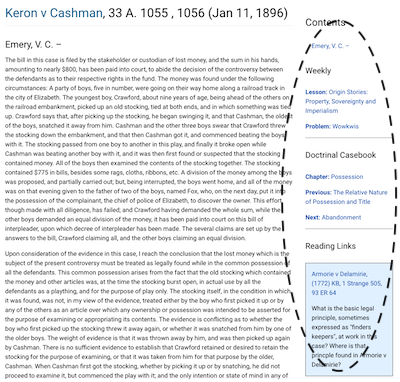
Notice that any time you are reading one of the assigned course materials in the casebook, the right side-bar provides links to the different aspects of the reading’s context. You can link directly to the Lesson and Problem, and find the reading in the Doctrinal Casebook. The “Reading Links” help you to find relationships to other readings in the course.