Origin Stories: Property, Sovereignty and Imperialism
This first lesson
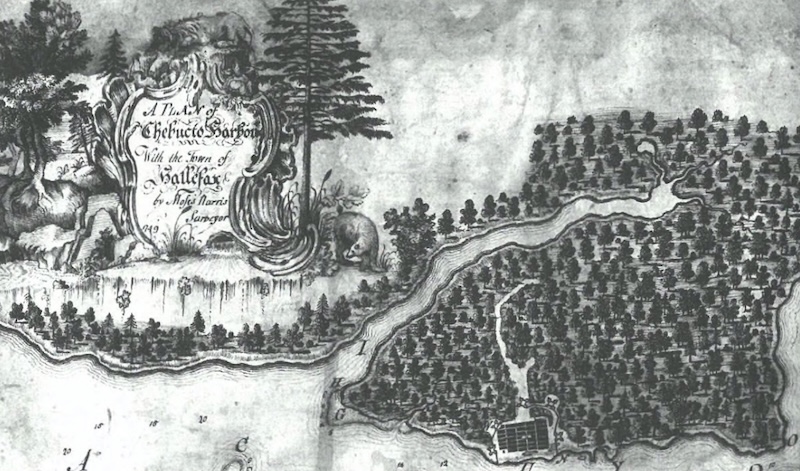
Moses Harris, Extract from unpublished Plan of Chebucto Harbour with the Town of Halifax, 1749. The British Library, Maps, K.Top.119 f73, excerpted in Jeffers Lennox, Homelands and Empires, 142.
Learning Objectives
Learning objectives are statements about the skills, knowledge and attitudes learners will acquire or develop when they complete this lesson.
By the end of this week, you should be able to:
- Test.
Property and British Imperial Aims #
Since the early period of British presence in Indigenous North America, “property” – legal relationships among a community with and about land and other things – has been a legal tool used by European colonial powers to advance their aims. That tool has taken different forms and served different functions over the several centuries during which colonialism has been at work. Close attention to these different forms and functions can help us to understand a great deal about where, how and when changing ideas and practices of property have been important in making Canada.
Indigenous peoples have long sought to draw attention to the fact that Canada is a country founded on the dispossession of Indigenous nations from their lands. The field of settler colonial studies has built on this long record of advocacy and resistance to show up colonial dispossession as an ongoing process of illegitimate and frequently violent taking and occupation of Indigenous lands–an idea that has started to resonate in broader public and political discourse. Alongside this trend is a growing awareness of the role that property in particular has played as a central instrument in this process.
At the same time, recent work in this area has urged us to consider carefully the different and shifting functions that property has played over the course of colonial history, and to be cautious about the extent to which we minimize or ignore the agency of Indigenous nations in confronting and navigating processes of colonialism.
In the context of this broader colonial history, the large-scale Indigenous dispossession from their lands did not become a central objective or pervasive reality of British colonial policy until around the start of the nineteenth century. An earlier era of colonialism, particularly in the Atlantic region beginning in the late seventeenth century, emphasized the “imperial/commercial penetration” of a continent that was still largely devoid of any European presence amid the vast territories that have been Indigenous homelands since time immemorial.1 Without question, acts of land dispossession, and certainly of heinous violence through arms and disease, were perpetrated against the Mi’kmaq and other Indigenous nations during this period – even as European states sought, as a first matter, to stake their imperial claims to sovereign authority in the Atlantic region vis-a-vis other colonial powers, to establish networks for trade in wild animals and other resources, and to forge Indigenous alliances while doing comparatively little to advance patterns of permanent colonial settlement on the ground. For their part, Indigenous nations sought to shape and contest the terms of British property and territorial claims through the an ongoing process of engagement in treaty-making.
What, then, were the roles and functions of “property” as a set of legal relations with and about land in this early context and what can these tell us about the connections between property and the Canadian state?
The map excerpted above was drafted by British cartographer Moses Harris in 1749, the year that Halifax was established in Mi’kmaw territory at K’jipuktuk (Chebucto Harbour) as a small military outpost under the direction of the Nova Scotia Governor Edward Cornwallis. The founding of Halifax took place on a rapidly shifting landscape of violent conflicts and fluid alliances between the Wabanaki (a confederation of five Indigenous nations including the Mi’kmaq), the French and the British. Amid these changing international power relations, there remained relatively few colonial settlements in the region (e.g. Louisburg, Annapolis Royal and now Halifax), and those that existed were largely isolated from one another by vast areas: “Nova Scotia” in the reality of any British control over land in the mid-eighteenth century “remained a collection of pales within an Indigenous homeland.”2 Whatever control over land–however tenuous–the British managed to sustain was much more a product of international political and military relations than of any legal rules about property as physical possession on the ground.
And yet, property in some form arguably still played a significant role in British colonialism during this period of time. If not yet a tool yet employed mainly for the physical dispossession of Indigenous peoples,
NB: focus on the idea that “property” in its particular Canadian form was being created at this time in the colonial context. History in Britain was about possession … but the reality in colonial NA was not really about possession, but about what Carol Rose calls property “speaking to the world”. This was intimately bound up with debates about the very origin of ideas of property: as a natural, pre-political relationship in the state of nature; as an act of state-issued power and coersion; as a kind of liminal space of inter-cultural collision. Go through each of these
Property as Imperial Imagination #
In exploring what functions property did serve during this period, consider another map created by Moses Harris just one year after Halifax was established, in 1750 – and this time published for British and broader European audiences back home. Very little had actually changed on the landscape during this year. How do the representations of land, territory, and wilderness compare between the 1749 and 1750 maps, and what does this comparison tell us about the significance of Halifax as a site of colonial possession, dispossession, property and sovereignty?
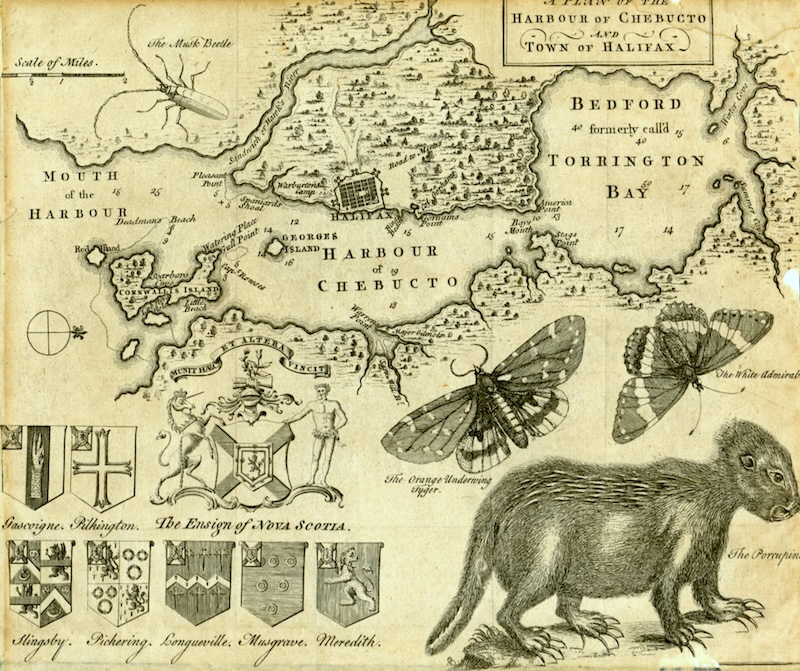
The question of what functions property served during this era of imperial/commercial penetration is closely tied to the conceptual question of property’s relationship to the state–a main focus of our reading materials this week. Is property created and enforced solely by government? Is it possible for property to precede or exist without government (i.e. the state)? Or is property in some way a possible link within more complex inter-national and legally pluralistic orders?
-
Allan Greer, “Settler Colonialism and Beyond” (2019) 30:1 Journal of the Canadian Historical Association 61. ↩︎
-
Jefferson Lennox, Homelands and Empires: Indigenous Spaces, Imperial Fictions, and Competition for Territory in Northeastern North America, 1690-1763 (Toronto: University of Toronto Press, 2017) at 130. ↩︎
Weekly Problem: Wowkwis
After you have read through the background for this week's lesson above, your next step is to review the weekly problem.

A Mi'kmaw hunter pursues a fox through the woods, where it is killed by a dog walking off-leash with its owner. You are asked to consider the possible legal relationships at play in a claim to ownership.