Origin Stories: Property, Sovereignty and Imperialism
Our course begins by examining different origins stories: stories about the origins or sources of property, but at the same time stories about the origins of 'Canada' and, before that, British North America and the broader British empire.
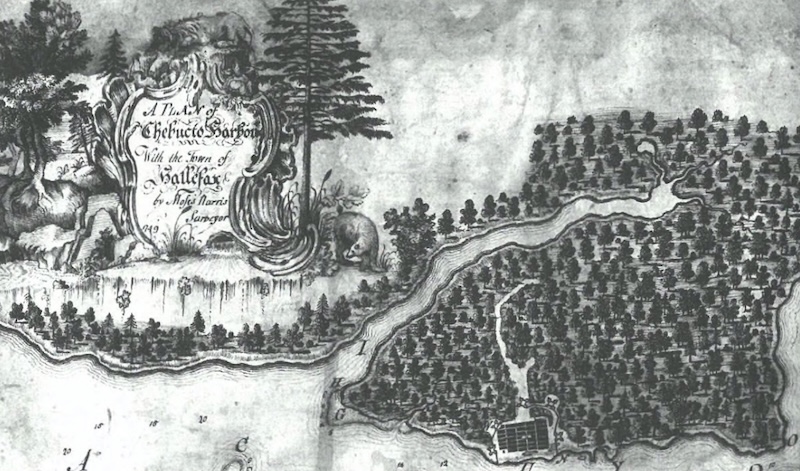
Moses Harris, Extract from unpublished Plan of Chebucto Harbour with the Town of Halifax, 1749. The British Library, Maps, K.Top.119 f73, excerpted in Jeffers Lennox, Homelands and Empires, 142.
Learning Objectives
Learning objectives are statements about the skills, knowledge and attitudes learners will acquire or develop in this unit.
By the end of this unit, you should be able to:
- Critically analyze property's different origin stories and functions during the early colonial period.
- Identify expressions of each origin story in the legal materials studied in the unit and apply these materials to a analyze a practical problem.
- Explain and use in practice the relationship between statutory and common law sources of property rights.
- Describe key common law principles about ownership of wild animals.
- Identify and apply the common law test for possession.
- Explain why the concept of relative possession matters for resolving disputes about possession and ownership.
Early Colonial Encounters #
Since the early period of British presence in Indigenous North America, “property” has been a legal tool used by European colonial states to advance their aims. That tool has taken different forms and served different functions over the several centuries during which colonialism has been at work. Close attention to these different forms and functions can help us to understand a great deal about where, how and when changing ideas and practices of property have been important in making contemporary Canada.
Indigenous peoples have long sought to draw attention to the fact that Canada is a country founded on the dispossession of Indigenous nations from their lands. The field of settler colonial studies has built on this long record of advocacy and resistance to show up colonial dispossession as an ongoing process of systematic, illegitimate and frequently violent taking and occupation of Indigenous lands—an idea that has started to resonate in broader public and political discourse. Alongside this trend is a growing awareness of the role that property in particular has played in the process.
At the same time, recent historiographical research on colonialism in North America has urged us to consider carefully the different and shifting functions of property over the course of colonial history, and to be cautious about the extent to which we minimize or ignore the agency of Indigenous nations in confronting and navigating processes of colonialism.1 “Property” in the Anglo-Canadian tradition was not and is not a legal concept cut whole cloth from European systems and engrafted onto the North American context. It emerged in relational encounters between Indigenous, French and British powers and within the shifting alliances and conflicts that characterized the period.
In the context of this broader colonial history, the large-scale Indigenous dispossession from their lands became a central objective and pervasive reality of British colonial policy around the start of the nineteenth century. An earlier era of colonialism, particularly in the Atlantic region beginning in the late seventeenth century, emphasized the “imperial/commercial penetration” of a continent that was still largely devoid of any European presence amid the vast territories that have been Indigenous homelands since time immemorial.2 Without question, acts of land dispossession, and certainly of heinous violence through arms and disease, were perpetrated against Indigenous peoples during this period—even as European states sought, as a first matter, to stake their imperial claims to sovereign authority in the Atlantic region vis-a-vis other imperial-colonial powers, to establish networks for trade in wild animals and other resources, and to forge Indigenous alliances while doing comparatively little to advance patterns of permanent colonial settlement on the ground. For their part, Indigenous nations sought to shape and contest the terms of British property and territorial claims through an ongoing process of engagement in treaty-making as well as armed conflicts and other forms of resistance.
What, then, were the origins and functions of Anglo-Canadian “property” as a set of legal relations with and about land in this early context and what can these tell us about the influence of property on what would become the Canada?
Rather than try to pinpoint a single answer to this complex question, our goal in this unit will be to identify and analyze at least three different legal origin stories for property that illustrate what different actors and interests at the time understood property to be doing. The question of what functions property served during this era of imperial/commercial penetration is closely tied to the conceptual question of property’s relationship to the state and to state governance—a main focus of our reading materials in this unit. Is property created and enforced solely by government? Is it possible for property to precede or exist without government? Or is property in some way a possible link within more complex inter-national and legally pluralistic orders?
Story One: Property as Possession #
The idea that possession is the origin of property relations (“nine tenths of the law”) has been and remains a closely held—even sacrosanct—principle in the Anglo-Canadian tradition. As this story goes, possession is manifested as physical control (dominium) and intention to control, and is both a necessary and sufficient condition for property, with or without the existence of a formal political community or any form of centralized or formalized government. This story aligns with a “natural rights” perspective on property as somehow inherent to humans’ relationships with land and their activities on the landscape.
The map excerpted at the top of this page was drafted by British cartographer Moses Harris in 1749, the year that Halifax was established in Mi’kmaw territory at K’jipuktuk (Chebucto Harbour) as a small military outpost under the direction of the Nova Scotia Governor Edward Cornwallis. The founding of Halifax took place on a rapidly shifting landscape of violent conflicts and fluid alliances between the Wabanaki (a confederation of five Indigenous nations including the Mi’kmaq), the French and the British. Amid these changing international power relations, there remained relatively few colonial settlements in the region (e.g. Louisburg, Annapolis Royal and now Halifax), and those that existed were largely isolated from one another by vast areas. “Nova Scotia” in the reality of any British control over land in the mid-eighteenth century “remained a collection of pales within an Indigenous homeland.”3
At least two messages emerge from Harris’s 1949 map in comparison to the one below, which he published just a year later. The first is the presence of wild animals in both maps: a mildly threatening bear among the trees in the early version; butterflies, beetles and porcupine in the latter. It seems relatively clear that from their earliest interests in exploiting natural resources in Indigenous homelands, the British recognized property in wild animals taken from a “state of nature”, whether harvested by Indigenous or European hunters. This often implicit recognition for possession as the basis for property underpinned the entire imperial economy of the time, with Europeans trading readily for the valuable skins—primarily beaver—to supply a voracious European market for felt and other materials.
When it came to property in land, however, the story about possession as the basis of property was both heavily contested and of much less practical significance. This is the second telling aspect of Harris’s 1949 map. When we look at the diminutive British settlement at K’jipuktuk set against to the surrounding wilderness, it seems unlikely that such an act of “possession” by Cornwallis—even over the explicit objections of the Mi’kmaq—could serve as the justification for some broader assertion of control over or ownership interest in the territory. Certainly, the awful violence that Cornwallis and his soldiers perpetrated against the Mi’kmaq in the events surrounding the founding of Halifax seems to reinforce the idea that force and fear–not possession or property per se–were primary means by which the British sought to establish their imperial status during this period.
Story Two: Property as State Authority and Coercion #
Moses Harris’s second map of Halifax from 1750 offers several clues about another possible origin story for property in the mid-eighteenth century Atlantic. If British claims to property or otherwise in land had little connection to physical possession and control on the ground, they were nevertheless expressed formally in some executive orders of the Crown–suggesting that real property rights, where the existed, were seen as emanating directly from the public authority of the British state. This is a very different story from the first one above, one that endows the state with a kind of monopoly over the creation and recognition of property. But as with claims based on actual possession, there was little reality to the idea that orders of a distant imperial power could be upheld through coercive enforcement over such a vast territory.
Instead, Harris’s 1750 map, published for audiences in Europe to entice would-be emigrants to North America, suggests that the real impact of state orders recognizing or purporting to create property in land were discursive rather than strictly legal: the British government sough to construct the story of property as a kind of imperial imaginary that treated such claims in North America “as if” they simply existed. In this sense, the function of property was to telegraph to the world how Britain wanted their territorial claims to be perceived and interpreted by others, regardless of what could be enforced by the colonial state in reality and on the ground.
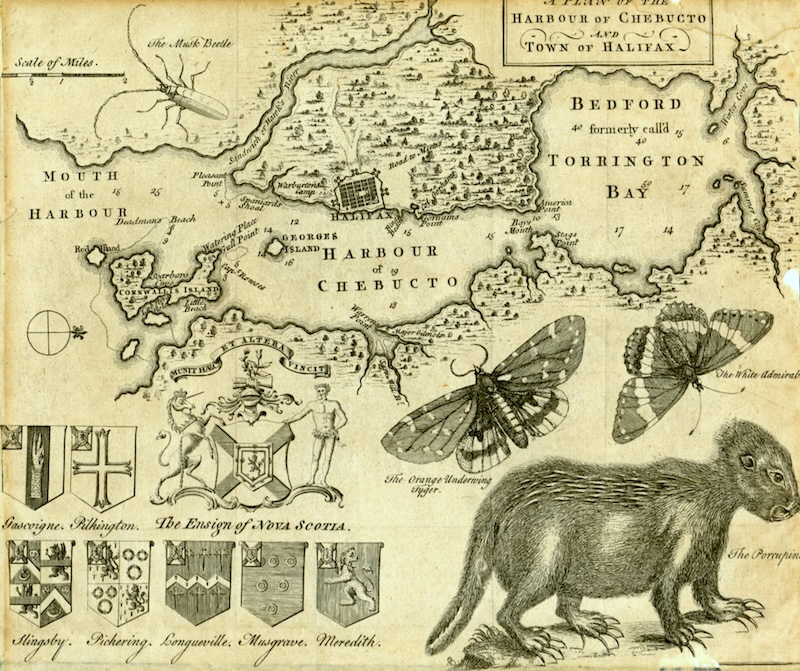
And just as the intended audience for Harris’s 1750 map is critical interpreting what it means, the real audience for much of British law related to land during this period was neither settlers nor their Indigenous neighbours, but other European powers against whom Britain was competing for political and military dominance in North America and elsewhere in the world. “Property” in this story was a highly contingent idea that depended very much on its intended audience.
Story Three: Property as Inter-national Relations #
Attempts to found Halifax and to construct early ideas of property in Mi’kma’ki were interposed between and within processes of treaty-making between the Mi’kmaq and the British—namely among two of the first Peace and Friendship Treaties in 1725 and in 1752. The treaties are significant not only in that the Mi’kmaq regarded Halifax in 1749 as a breach of the treaty relationship, or that the 1752 was an attempt in part to repair that relationship, or that the treaties clearly disclosed no attempt by the Mi’kmaq to cede their sovereignty or rights in the land. The Peace and Friendship Treaties are also significant in that they represent an induction of the British into an existing inter-national legal order among Indigenous nations which pre-existed British imperialism and colonization.
To the extent that these treaties established terms for recognizing what might be called “property”, such as through protections for Mi’kmaw hunting rights, these concepts emerged not from some pre-political state of nature, nor from the coercive power of a singular and sovereign nation-state, but from a kind of collision between cultures, worldviews and legal orders. Of course, much remained unsaid and unwritten–perhaps to recognize and in some sense preserve the inevitable contradictions and inconsistencies that exist in such a legally pluralistic story.
None of this is to ignore the asymmetries at play in terms of power relations, the devastating effects of war and disease, or the long-term consequences for Indigenous communities of European powers privileging their own ideas and interests about property. But the function of this story about property was to hold open rather than foreclose the structure of land relations within a rapidly changing inter-national context and present the possibility of building ongoing relationships over time, including opportunities to repair harm.
Property and Sovereignty #
Probably the most difficult thing to untangle in answering our question about the origins and functions of property in the early colonial period is to distinguish between claims to “sovereignty” (as the authority of nations to make and enforce its own laws) and claims to “property” (as claims to land held by particular legal persons). While these two concepts would become easier to separate as British sovereignty was increasingly asserted and assumed by Anglo-Canadian law and legal institutions, during the period we are studying in this unit the line between them appeared much muddier.
What is clear is that, from the perspective of the British colonial state, its primary focus was on bolstering its obviously uncertain and contested claims to territorial sovereignty in North America and that forms of and stories about property emerged in this era as largely instrumental to that end. Much of this then laid the groundwork for era of intensive settler colonialism to follow.
-
Ned Blackhawk, “The Rediscovery of America” (Yale University Press, 2023). ↩︎
-
Allan Greer, “Settler Colonialism and Beyond” (2019) 30:1 Journal of the Canadian Historical Association 61. ↩︎
-
Jefferson Lennox, Homelands and Empires: Indigenous Spaces, Imperial Fictions, and Competition for Territory in Northeastern North America, 1690-1763 (Toronto: University of Toronto Press, 2017) at 130. ↩︎
Problem: Wowkwis
After you have read through the background for this week's lesson above, your next step is to review the weekly problem.

A Mi'kmaw hunter pursues a fox through the woods, where it is killed by a dog walking off-leash with its owner. You are asked to consider the possible legal relationships at play in a claim to ownership.